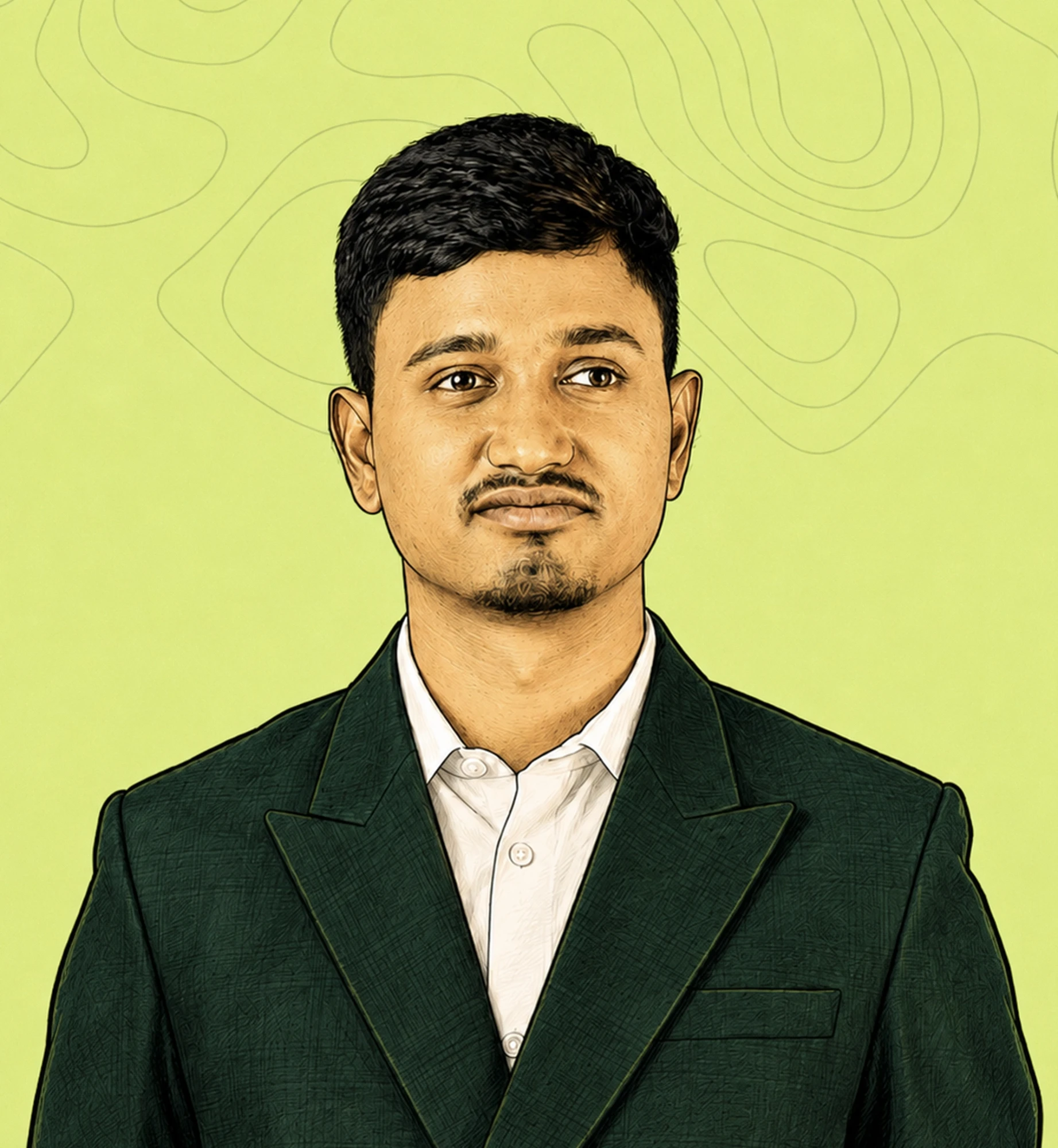
Nasher Uddin
I've spent 5 years figuring out how to make AI work in the real world — not demos, not prototypes, but live systems that handle real users every day.
I think in systems. I move fast. I care about what actually ships, not what sounds good in a pitch deck.
By the numbers
Not milestones I planned — things that happened because I kept showing up.
What I do
I build AI systems — and I've been doing it long enough to know what actually works and what doesn't.
I co-founded Riverborn because I wanted to build AI that earns its keep — systems that run in production, handle real load, and actually solve the problem they were built for.
I run operations, drive product decisions, stay close to clients, and personally make sure nothing ships unless it's ready. The rule I hold myself to: if I haven't run it on something we own first, it doesn't go to a client.
AI Agents
Multi-step reasoning, self-correction, persistent memory. I've shipped agents that run autonomously across real business workflows.
Voice AI
LLM-native voice on real telephony. Sub-2s latency. I built Vocalo.ai from scratch — I know this space from the inside.
RAG & Chatbots
Retrieval systems that actually retrieve the right thing. I've built and maintained these across multiple live products.
Generative AI
Image, audio, video generation pipelines. I've shipped creative AI products to tens of thousands of users.
Multi-Agent Systems
Orchestrated agent networks where planning, execution, and feedback work together. I architect these end to end.
Operations & Delivery
Not just building — running. I manage teams, set delivery standards, and stay in the room until the thing actually works.
How I think
These aren't frameworks I read somewhere. They're what I've learned from actually building things.
Prove it on yourself first
If we haven't run it on our own products, we don't sell it.
Ship, then improve
Real usage teaches more in a week than six months of planning ever could.
Say what you actually think
Honest feedback early costs less than polite silence later.
Curiosity over credentials
The best work comes from wanting to understand, not just wanting to qualify.
Consistency is the skill
Showing up when it's slow matters more than performing when conditions are good.
Context changes everything
The right solution depends on the actual problem — there are no universal answers.
Beyond the Screen
What I actually think about when I'm not building things
I haven't left Bangladesh yet — but I've been exploring it properly, and there's more here than most people realise. Hill tracks in Bandarban, rivers that cut through everything, ancient mosques and ruins that most people drive past without stopping. I'm still working through what's on my doorstep before I move further.
But the list is building. Mountains, ancient civilizations, coastlines of other seas — the world has a lot of places I intend to get to. I'm drawn to nature that makes you feel small and history that makes you feel connected to something much longer than your own lifetime. The two together are hard to beat.
Travel
Haven't gone international yet, but it's coming. I've been exploring Bangladesh first — and it's a bigger country than most people give it credit for. The plan is to keep moving outward from here: neighbouring countries, then further. I'm not interested in the obvious tourist circuit. I want to find the places one stop further down the line, the regions most people skip, the towns that still feel like themselves. Those are usually where the real character is.
Ancient History
This one started close to home. Bangladesh has Mahasthangarh — one of the oldest archaeological sites in the subcontinent, dating back to the 3rd century BC. The Mosque City of Bagerhat, a UNESCO site with sixty domes. Paharpur, a Buddhist monastery that's been here since the 8th century. Sonargaon, an ancient capital most people have never heard of — that one is on my list. I want to get to all of these properly, not just pass through. And beyond Bangladesh — the Middle East, Central Asia, the ancient world — that's further down the list but it's there.
Hills & Mountains
The Chittagong Hill Tracts pull me in — Bandarban, Rangamati, those long roads that go into the hills and keep going. Keokradong, the highest accessible peak in Bangladesh, and Sajek Valley are both on my list. There's a specific quality of silence you find only at elevation: no traffic, no notifications, just wind and distance. It resets something. The Himalayas are a bigger ambition for later. The Sylhet tea gardens are also somewhere I want to get to — a different kind of landscape but the same pull.
Seas & Rivers
Growing up in Bangladesh means growing up alongside rivers — the Padma, the Meghna, the Jamuna. Water is in the DNA of this landscape. Cox's Bazar has the longest natural sea beach in the world and it's right here. Kuakata — where you can watch both sunrise and sunset over the sea — is on the list. Rivers and coastlines have a pace that's completely different from cities or mountains. They remind you that the world keeps moving whether you're watching or not. I find that useful.
Things I've built
Every one of these is live, used by real people, and something I personally had a hand in shipping.

Gamify language learning with immersive AI conversations, personalised curriculum, and real-time comprehensive feedback.

Turn simple sketches into stunning, photorealistic artwork using AI diffusion models.

Experience natural conversations with an expressive 3D AI assistant that sees, hears, and understands.

Generate professional-quality product photography and content without traditional photography equipment.

Create interactive quizzes and tests with AI-powered question generation and evaluation.

Craft immersive stories with AI-generated narratives, visuals, and audio experiences.

AI-powered invoice automation tool that extracts, processes, and manages invoices from emails and manual uploads with 99.9% accuracy.

Say hello
I read every message. If something I've built or written resonates with you — I'd genuinely like to hear it.